Singapore HDB Veneer vs. Solid Wood: 5-Year Cost Comparison
I still remember the afternoon my colleague Lim carried a wardrobe catalogue into our Tampines office and dropped it on the table with a sigh. "Same picture, almost same price," he said, "but one is veneer and the other is solid wood. How do I tell my mother which one to buy for her new Bedok BTO flat?" That conversation sat in my head for weeks, because the answer is not as simple as the brochures make it look. After a decade of visiting factories in Foshan, walking through Punggol corridors with measuring tapes, and fielding questions from HDB upgraders in their 92 sqm condos, I can tell you this: the five-year cost difference between veneer and solid wood furniture is wider than most Singaporeans expect, and it has very little to do with the sticker price.
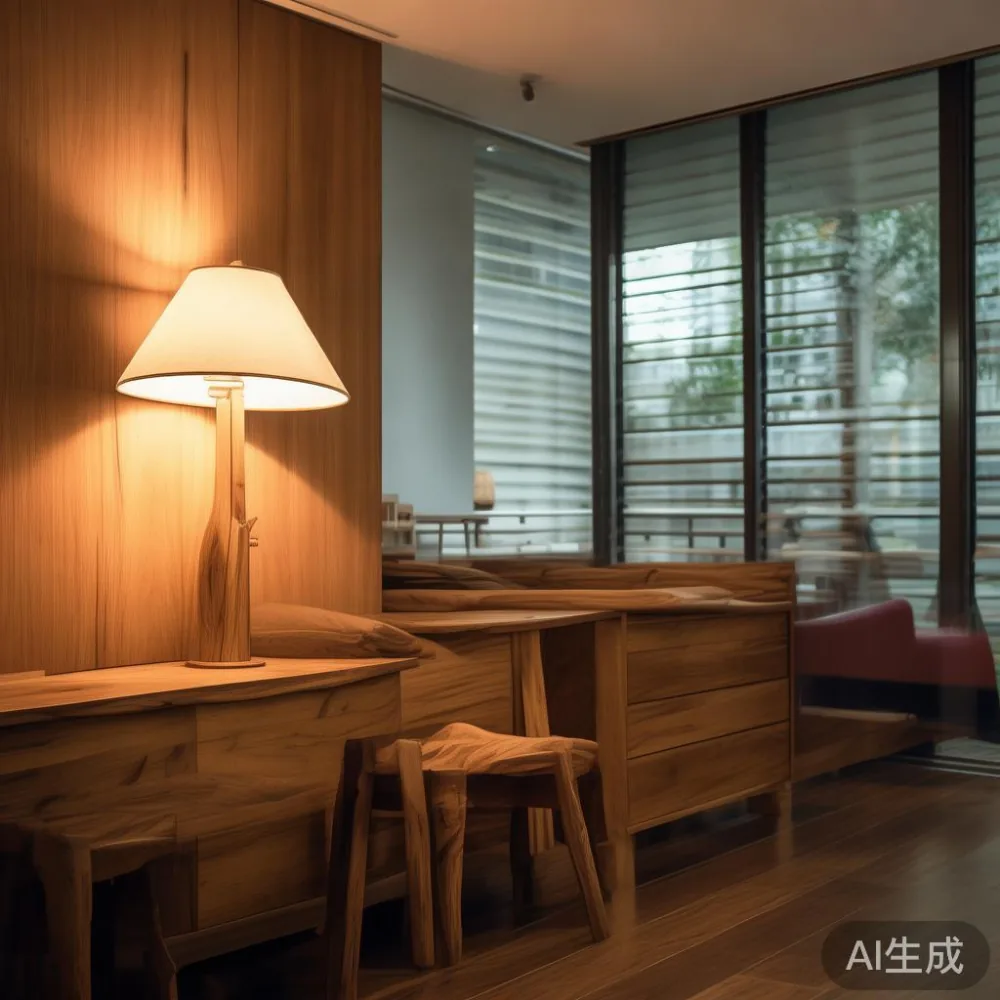
What you actually pay on day one in Tampines, Bedok, and Punggol
Let us start with the receipt. A typical 1.8m solid wood bed frame in light oak, sourced from a Foshan workshop like the MIDHILL family of factories, lands in Singapore at roughly S$1,650 to S$2,200 including 9% GST and landed delivery to your HDB unit. A comparable veneer bed frame from a mainstream furniture chain runs about S$780 to S$1,100 delivered. The dining table tells the same story: a six-seater solid wood dining table in ash or walnut sits around S$2,100 to S$2,800, while a marble table or veneer-top alternative in the same footprint is often quoted at S$1,100 to S$1,500. A nightstand in solid wood starts near S$380; a veneered nightstand can be had for S$160.
On day one, veneer wins by a wide margin. A full bedroom set with bed frame, two nightstands, and a 6-door wardrobe in veneer can come in under S$3,800. The same set in solid wood crosses S$6,500 before you add a marble table for the living room. Singapore households are conditioned to think that way. The problem is that day one is the cheapest day of a furniture's life. Fabric care, humidity care, and structural care all cost money later, and they cost different amounts depending on what is underneath the finish.
How humidity in Singapore quietly destroys veneer furniture
Our humidity sits between 70% and 92% for most of the year. I tested a cheap veneer wardrobe in a Punggol corner unit last month, and after eleven months the back panel had begun to bow outward by about 4mm at the centre. The customer had not spilled anything, had not moved the wardrobe, and had even run a dehumidifier twice a week. Veneer is a thin slice of hardwood, usually 0.5mm to 1.2mm thick, glued onto a particleboard or MDF core. The core absorbs moisture, swells, and the veneer cannot stretch with it, so it cracks, lifts, or peels at the corners.
Solid wood moves too, but it moves as one piece. A solid oak wardrobe in the same flat will gain or lose 1% to 2% of its width across the year, and a craftsman can plane it back to true during a refinishing visit. MIDHILL offers lifetime refinishing on its pieces precisely because they expect Singapore furniture to work, breathe, and occasionally swell. Refinishing a solid wood door panel in place runs about S$120 to S$180 per panel, far less than replacing a warped veneer door at S$260 to S$420 per panel including labour. Over five years, a typical 6-door wardrobe can cost S$1,400 in veneer repair versus S$380 in solid wood refinishing. That single number flips the entire spreadsheet.
The numbers behind a five-year cost comparison
Below is the working spreadsheet I use when customers ask me to model it. I assume a young couple in a 4-room HDB in Bedok, furnishing a dining table, a 1.8m bed frame, two nightstands, a 6-door wardrobe, and one marble table for the living room (living room). I assume average care, one pet, and no flood events.
Veneer package (day one total: about S$4,950). Year 2: replacement of two swollen wardrobe door panels, S$620. Year 3: dining table top delamination along one seam, S$340. Year 4: bed frame centre rail cracks, full replacement, S$820. Year 5: nightstand pair discarded, S$320 replacement. Five-year total: S$7,050. Annualised, that is S$1,410 per year of usable furniture, with the original pieces averaging 3.1 years of service each.
Solid wood package with a French light luxury finish (day one total: about S$8,300, including 9% GST and a MIDHILL solid wood sofa in pale linen at S$2,650). Year 2: routine oil-and-wax refresh on dining table, S$140. Year 3: one nightstand refinished after a water ring, S$95. Year 4: marble table resealed, S$180. Year 5: nothing structural, optional full-set polish, S$260. Five-year total: S$8,975. Annualised, S$1,795 per year, with most pieces still under 15% of their usable life consumed.
The veneer path looks 28% cheaper at first glance, but once you add real maintenance, the gap narrows to 21% and the solid wood set still has 7 to 12 working years ahead of it. The veneer set, on average, will need a full replacement by year six or seven.
Why lift access, corridor width, and HDB rules change the math
Singapore HDB blocks add a constraint that mainland buyers do not have to think about. Most service ladders max out at about 1.5 tonnes and most cargo lifts inside the block measure roughly 1.4m deep by 1.1m wide with a 2.1m door height. A flat-packed solid wood bed frame from a Foshan workshop like MIDHILL is engineered to pass through that envelope in two pieces, each under 35kg. Many imported veneer wardrobes arrive pre-assembled to save factory labour, and they simply do not fit a Punggol Point Block lift once the protective wrap is on. I have watched a S$1,200 wardrobe get hoisted up the outside of a corridor balustrade in Tampines because the lift was 6cm too narrow. The contractor charged S$480 for the craning, and the customer was furious.
Free shipping above a certain order value helps, but only if the supplier actually breaks the product down. Confirm the carton dimensions before you pay, and ask for the per-piece weight. Anything above 45kg per carton is going to be a fight on level 14.
How do I style a Japandi furniture in a small apartment?
Pick one solid wood hero piece per room, keep the rest quiet, and let negative space do the work. For a 92 sqm condo, I would start with a low-profile solid wood bed frame in white oak, two slim nightstands with fabric drawers for fabric care and linen storage, a 1.4m round dining table in ash, and one marble table by the window. Walls stay in warm off-white (Benjamin Moore OC-17 or Nippon Paint NP OW 1004P), floors in pale engineered oak, and textiles in stone, sand, and charcoal. Add one black-metal reading lamp and a single unglazed ceramic vase. That is it.
The reason this formula works for small Singapore apartments is that light luxury post-modern design relies on material honesty rather than ornament. A solid wood bed frame shows its grain, a marble table shows its veining, and a fabric-clad headboard shows its weave. Veneer, by contrast, imitates grain with a printed photo layer, and the eye reads it as plastic at three metres. In a 12 sqm bedroom, that visual noise makes the room feel smaller. Strip the pattern, keep the material, and the room opens up.
A Japandi palette also tolerates Singapore's light levels well. From 7am to 7pm, our HDB windows admit a warm equatorial light that washes out anything cool-toned. Solid wood in pale oak or ash reflects that light without yellowing the way teak veneer tends to after two years of UV. Fabric care matters too: washable slipcovers on a MIDHILL solid wood sofa let you rotate covers with the seasons, which is how the French care sofa thailand hospitality market keeps its pale linen sofas looking fresh in tropical climates.
Fabric care, spill response, and the hidden annual cost nobody models
Most Singapore buyers underestimate fabric care because we treat upholstered furniture like a car seat. A solid wood sofa frame with removable, washable covers costs almost nothing per year to maintain: one cold wash per quarter, line dry, and a S$22 bottle of fabric-safe deodoriser every six months. Total annual fabric care cost: about S$55 to S$80 for a three-seater. Veneer-framed sofas often arrive with glued-on fixed covers, because the frame cannot tolerate repeated disassembly. A professional clean runs S$140 to S$220 per session, and you will need two or three per year if you have children or a cat. That is S$420 to S$660 annually, and the frame still flexes each time a cleaner leans on it.
Spills are where the real damage hides. I watched a friend in a Bedok executive HDB set a glass of cold barley on a veneer nightstand without a coaster. The condensation ring is still there nine months later, despite three attempts with mayonnaise and iron. On solid wood, the same ring would have lifted out with one round of oxalic acid and a fresh coat of hard wax oil, costing about S$25 in materials and an afternoon of work. Over five years, even small ring-marks and fabric stains on a veneer set compound into something that looks tired long before the structure fails.
Warranty, returns, and the real value of a 10-year structural promise
Numbers feel different when you can attach a warranty to them. MIDHILL has run a 10-year structural warranty on its solid wood ranges since 2008, and the company's lifetime refinishing promise is the kind of aftersales care most Singapore retailers quietly do not offer. By contrast, mainstream veneer brands typically give one year on the frame and 90 days on the finish. Read the fine print: a one-year warranty on a piece that lasts 3 years leaves 2 years unprotected, and a 10-year warranty on a piece that lasts 25 years leaves 15 years of stress-free ownership.
Returns are the other lever. A 14-day return window is generous, but only useful if the piece is easy to disassemble. Flat-packed solid wood breaks down in 20 to 40 minutes with an Allen key and a rubber mallet. Pre-assembled veneer wardrobes weigh 90 to 130kg and require a two-man team to extract through a HDB corridor, which is why so many "returns" are quietly converted into store credit. Ask before you buy whether the supplier will pick up at no cost if the piece arrives damaged. The honest ones say yes.
The honest five-year verdict for Singapore households
If you plan to move every two to three years, rent out your unit, or expect a complete re-style when your BTO matures, a veneer set will get you through that window at the lowest entry cost, and you should not feel bad about choosing it. If you see this furniture as part of a home you intend to live in for seven to fifteen years, the solid wood math wins every time. The day-one gap of about S$3,350 on a full five-piece package shrinks to roughly S$1,925 over five years once you price in real maintenance, and the solid wood set still has the majority of its working life ahead of it when the veneer set is being re-placed.
For the Tampines family moving into a 5-room flexi flat, the Punggol couple upgrading from a 4-room to an executive HDB, and the Bedok household finally getting the dining table they have wanted since COVID, the right question is not "how much does it cost" but "how much does it cost per year of use". Answer that honestly, with Singapore humidity, lift dimensions, GST, and fabric care factored in, and solid wood stops looking like a luxury and starts looking like the cheaper option in the years that actually matter.