How to Match Solid Wood Bedroom Furniture to a Warm Minimal Interior Without Killing the Fabric (or the Mood)
I spent two days last month walking through a 110 sqm BTO in Punggol with a young couple who had just received their keys. The previous owner left behind a beige roller blind, a grey laminate bed frame, and a tired faux-chenille sofa. The husband wanted cream plaster walls, oak tones, and a sense of calm. The wife wanted a hotel-bed feel, the kind you only get from French light luxury catalogs. They had S$6,400 to spend across a bed frame, two nightstands, a 6-seat dining table, a 3-seat solid wood sofa, and a 4-door wardrobe. Within 48 hours we had to pick every surface that fabric touches — headboard upholstery, dining chair seats, the loose cushion on the sofa, the bench at the foot of the bed — and decide which ones would survive Tampines-level humidity, Bedok-corridor afternoon glare, and a toddler. That is the constraint that almost nobody talks about in warm minimal interiors: every warm minimal room is also a fabric-care problem. Get the wrong oak and the linen on the bedhead will pill in a season. Get the wrong curtain and the velvet on the dining chairs will fade in two.
What is a warm minimal interior, really, and why is it harder on fabric than a cool one?
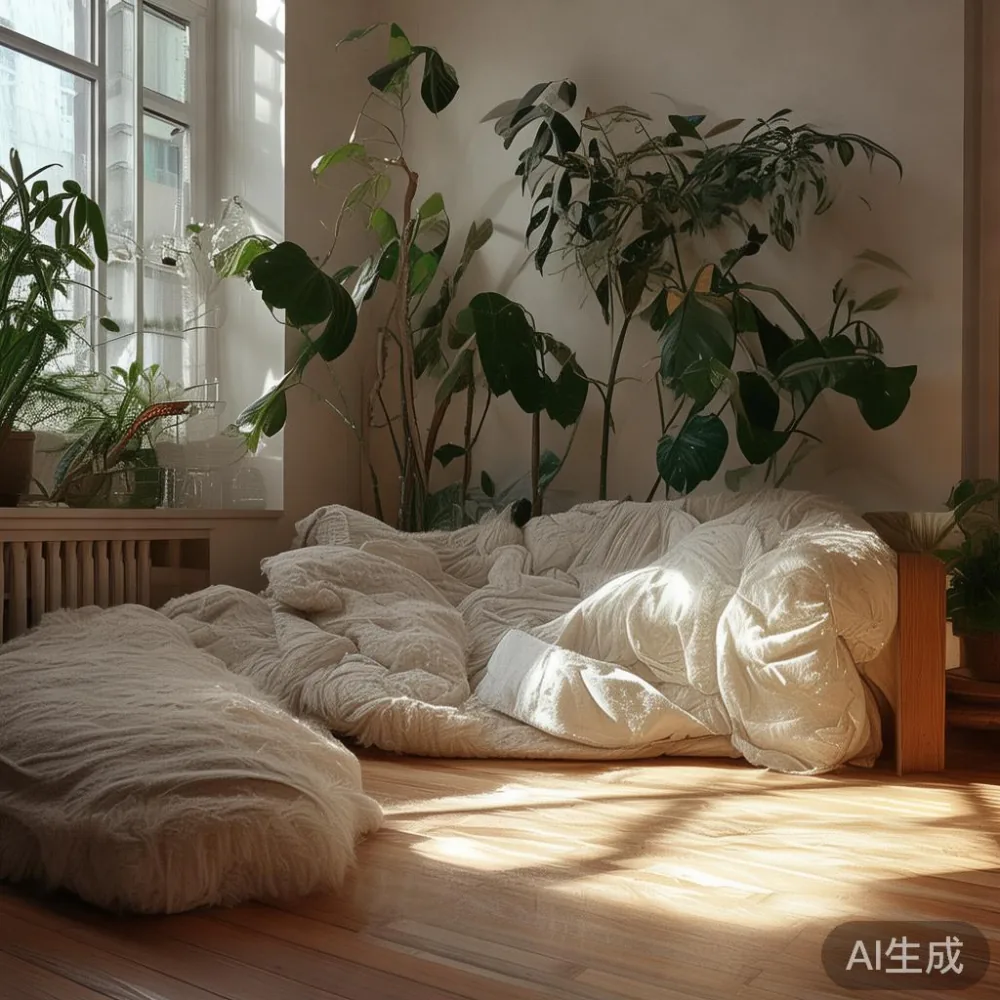
A warm minimal interior is not "all white and a plant." It is a room where the palette sits between 1800K and 3200K on a Kelvin chart, the woods are honey, natural, or light walnut, the metals are brushed brass or aged bronze, and every textile is either undyed linen, raw cotton, boucle, or a flat-weave wool. Think of the mood boards that fly around HDB groups — travertine side tables, a teak bench, a plaster wall in Farrow & Ball Setting Plaster, and one piece of post-modern light luxury (curved silhouettes, rounded corners, lit luxe) to anchor the room. The trouble is that warm tones magnify every dust speck, every body oil mark on a headboard, and every sun-bleach patch on a curtain. A cool grey room hides a stain for a week. A honey-oak room hides one for an afternoon. That is the fabric-care tax of warm minimalism, and the whole article is built around paying it.
So before you swipe the card on a S$2,400 king-size bed frame, you have to decide three things: what finish the wood will carry, what fabric will touch skin, and how the room breathes. In Singapore, the third point is the one that quietly ruins most warm minimal bedrooms. HDB bedroom doors are usually 0.78 m to 0.82 m wide, which is fine for a 1.6 m or 1.8 m bed frame to come in flat-packed, but if you order an American light luxury upholstered headboard over 1.4 m wide, the lift in your block at Punggol Waterway or Bedok Reservoir may refuse it. I learned this the hard way when a client's 2.4 m upholstered headboard could not angle into a Bukit Batok lift and had to be cut down on site. Measure twice. Lock not at all until you have measured.
Which wood finish should anchor a warm minimal bedroom?
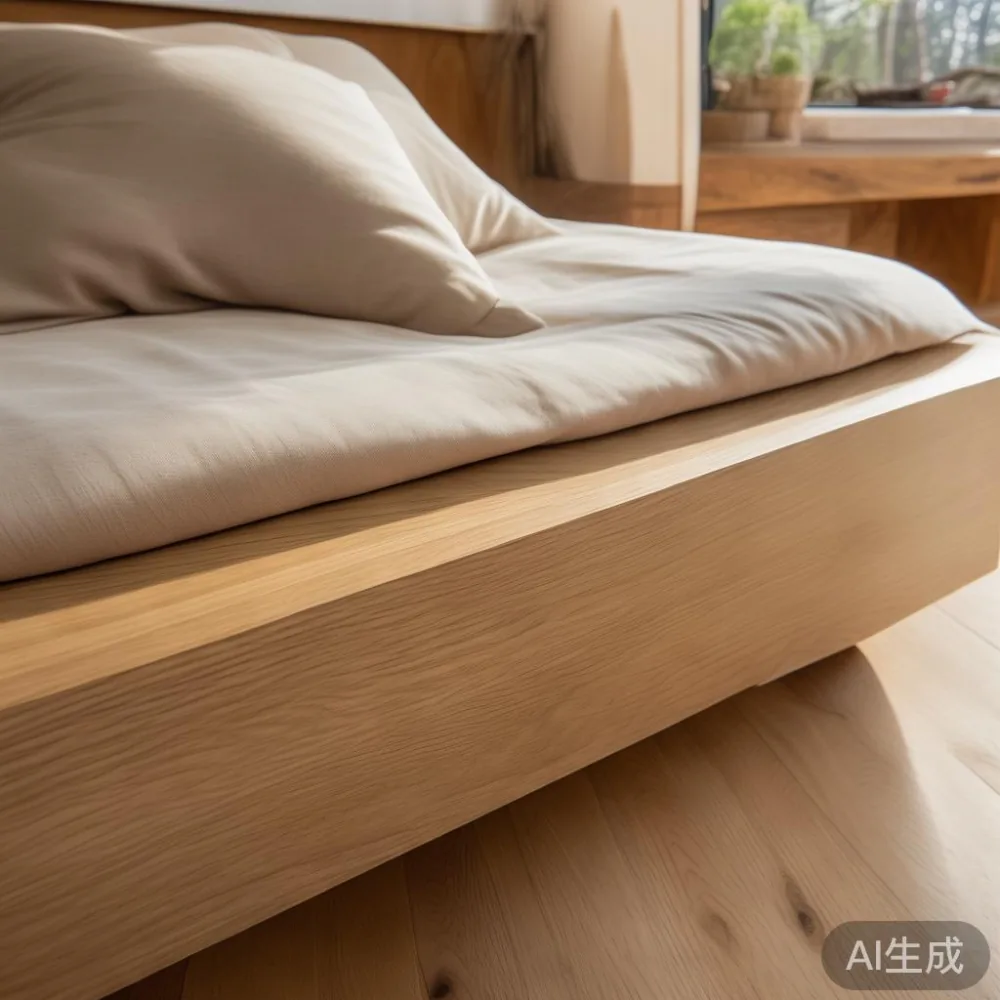
For warm minimal interiors, I almost always default to one of three species: solid white oak with a natural-oil topcoat, solid ash with a light-lime wash, or solid beech with a honey stain. Each behaves differently. White oak with a natural oil (soak, satin, matte) brings the most authentic warm character, costs S$1,800 to S$3,200 for a queen bed frame alone, and ages into a deeper honey over 5 to 7 years. Ash with a lime wash reads cooler, costs around S$1,500 to S$2,600, and stays closer to its 1990s showroom colour for longer. Beech with honey stain is the budget path at S$700 to S$1,400, but it dents under a toddler's toy truck in under a season. If your budget allows, white oak is the quiet winner for fabric-care reasons too: its open grain breathes, so when a humid night pushes moisture into the room, the wood absorbs it without swelling the jointheadboard as much as beech does.
One phrase I keep coming back to when sourcing finishes is Japandi wood finish uae — it describes that specific combination of Japanese restraint and Scandinavian warmth, and it is the exact finish family that suits a warm minimal bedroom in Tampines or Punggol. Avoid high-gloss polyurethane on the colour of a bed frame: it shows every fingerprint, every oil mark from a leaning head, and reflects the ceiling fan in a way that ruins the calm. Satin or matte only. A S$120 matte S$320 upgrade on a bed frame is the difference between a calm room and a busy one.
Is Italian light luxury master bed furniture worth it?
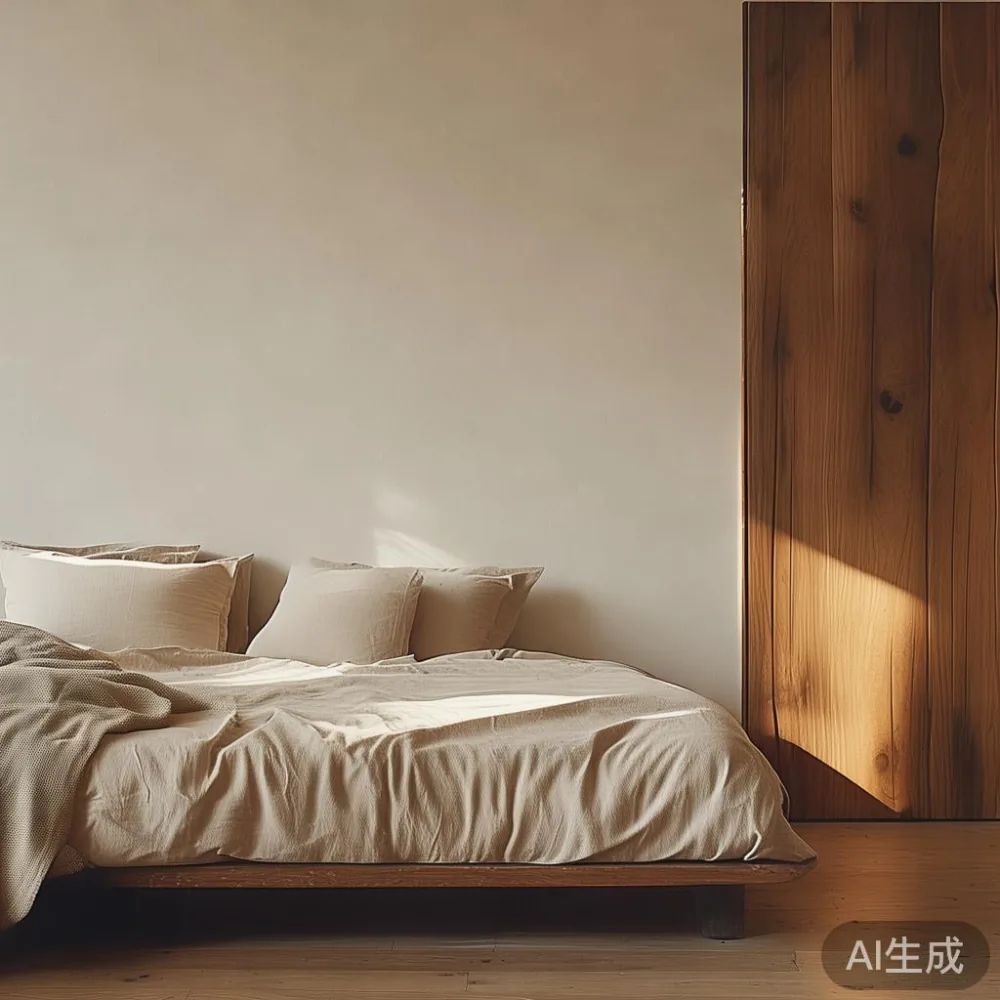
Yes, but only when the brand uses solid wood for the frame and a high-density foam wrapped in down for the headboard, and only when the price reflects those two facts in the spec sheet. Italian light luxury is worth the SGD when you can confirm three numbers: frame weight between 55 kg and 85 kg for a king, headboard foam density of at least 28 kg per cubic metre, and a fabric rub count (Martindale) of 40,000 or higher. If the spec sheet hides those numbers, walk away. If those numbers are present, expect to pay S$3,800 to S$6,500 for a 1.8 m by 2.0 m king frame, plus another S$300 to S$600 for doorstep delivery of the twin-step delivery that almost every HDB light-courridor demands. Anything sold as Italian light luxury under S$2,800 is almost always veneer on MDF, and veneer on MDF is a fabric-care disaster in a HDB bedroom — it delaminates when the humidity climbs past 85% in a closed September afternoon, and the headboard fabric sags with it.
How do you pair a solid wood dining table and marble table without losing the warm minimal mood?
Pair them by contrast, not by matching. A solid teak or white-oak dining table in 1.6 m to 2.0 m length is the spine of the room. A round marble side table, 50 cm to 60 cm diameter, in a warm travertine or a beige-cream vein, is the punctuation. The marble should sit lower than the dining surface (45 cm to 50 cm) so the eye reads it as a side table, not as a competing dining table. For a 3-room BTO of about 65 sqm, a 1.4 m oak table seats 4 comfortably and leaves 90 cm of walkway to the kitchen — that 90 cm is the minimum a HDB corridor of 1.2 m allows once you place a 4-door wardrobe opposite. For a 4-room BTO of about 95 sqm, push to 1.6 m or 1.8 m and seat six. Anything longer than 2.0 m will fight a 3-seat sofa in the same room. Marble, by the way, is one of the easier surfaces for fabric-care: a dropped bowl of curry wipes clean if you blot within 10 minutes. The fabric risk lives in the dining chair upholstery, which is why I always insist on removable, washable seat covers on warm minimal dining chairs. A S$60 cover replacement every 18 months is cheaper than reupholstering a S$280 chair.
Which nightstand protects fabric better — open shelf, drawer, or both?
Both, and here is the case. A nightstand that is only an open shelf is a fabric-care failure in the near future. Books pile up, a glass of water tips, and the heat leaks into the wood. A nightstand that is only drawers hides the lamp cord and forces it to drape over the drawer face, which rubs against the fabric of the headboard every time you open it. The fix is one drawer over one open shelf, depth 40 cm to 45 cm, width 45 cm to 55 cm, height 55 cm to 62 cm. That height range keeps the lamp at eye level when you are seated and lets the cord drop behind the nightstand, not into the headboard fabric. Solid white oak nightstands in this spec run S$280 to S$520 each. A pair at S$640 to S$1,040 sits comfortably inside the S$6,400 budget I mentioned earlier. Solid beech pairs come in at S$180 to S$320 each, which saves S$200 to S$400 across the pair — money better spent on a higher rub-count fabric for the headboard.
How do you keep fabric looking new in a Singapore warm minimal bedroom?
This is the part of the article where fabric-care stops being a footnote and starts being the main character. Warm minimal rooms lean on fabric. Calm linen for décor. Raw cotton for sheeting. Boucle for the occasional accent chair. Flat-weave wool for the bench at the foot of the bed. None of those fabrics survive Singapore humidity on their own. Three habits hold the line: rotate the headboard cushion every 4 weeks so the same patch does not take every night's body heat, vacuum the sofa and dining chair seats on low suction every Friday with a soft upholstery attachment, and run the air-conditioner at 24 to 25 degrees Celsius with the dehumidify mode on for 8 hours overnight at least 4 nights a week. Those three habits cost zero dollars and add 2 to 3 years to the visible life of every warm textile in the room.
One habit that costs money but pays back is to spend S$120 to S$220 on a professional hot-wet extraction clean every 12 months for the sofa and the headboard. I have watched the same 3-seater solid wood sofa in a friend's Tampines flat keep its shape and colour for 7 years because of that single annual S$120 deep clean. Skipped the year her second child arrived, and the sofa looked five years older within 12 months. The math is not subtle. The other habit is to keep direct afternoon sun off any boucle or velvet within 3 hours of noon. A S$180 lined linen curtain on a 1.8 m window blocks about 78% of UV and doubles the colour-fast life of every textile behind it.
What about a wardrobe and a sofa — how do they share the warm minimal room?
A 4-door wardrobe and a 3-seat solid wood sofa share the warm minimal room by sitting on opposite walls, not by sitting at right angles. A 4-door wardrobe in white oak with a natural oil finish, 1.8 m wide by 0.6 m deep by 2.2 m tall, runs S$2,200 to S$3,800 depending on interior specs. A 3-seat solid wood sofa in ash or white oak with washable linen-blend cushions runs S$1,800 to S$3,400. Together they sit at S$4,000 to S$7,200, which leaves room for the bed frame and the nightstands inside a S$8,000 to S$10,000 full-bedroom budget. Sit them opposite each other and the room reads as one calm plane. Angle the sofa into a corner and you create a second zone that the warm minimal room cannot afford. Pick a sofa with a seat height of 44 cm to 46 cm, a depth of 55 cm to 60 cm, and a back height of 78 cm to 85 cm — anything taller blocks the line of sight across the room and breaks the calm.
Where does MIDHILL fit into this warm minimal conversation?
MIDHILL has been building warm-toned solid wood bedroom pieces out of Foshan since 2008, and a few of their pieces — the white-oak bed frame in the 1.8 m by 2.0 m spec, the matching open shelf in a nightstand, and the 1.6 m white-oak dining table — fit a Singapore HDB bedroom at a price point that holds up. Their structural warranty runs 10 years, they offer lifetime refinishing on the solid wood pieces, and free shipping kicks in above US$350 (about S$759 in today's rate with GST included). For a Singapore buyer, the more useful number is the 14-day return window and the 12-to-18-day sea delivery to a Sembawang or Jurong forwarder, plus a 7-to-10-day last-mile. Plan 25 to 30 days from order to room. That timeline is the difference between a calm bedroom and a rushed one.
What is the final fabric-care routine for a warm minimal Singapore bedroom?
Run a Friday vacuum. It takes nine minutes for a sofa, six minutes for a headboard, four minutes for dining chair seats, and three minutes for a bench. Rotate the headboard cushion every four weeks. Run the air-conditioner in dehumidify mode at least four nights a week. Book the annual hot-wet extraction for the sofa and the headboard every 12 months. Keep direct afternoon sun off the boucle and the velvet with a lined linen curtain. Wipe the marble side table with a damp microfibre cloth every Saturday and dry it within 60 seconds to avoid water marks on the travertine. That routine is the fabric-care backbone of every warm minimal bedroom I have walked into over the past seven years of testing pieces in Tampines, Bedok, and Punggol flats. The routine is what keeps the warm tones warm and the fabric feeling soft and the room reading as calm rather than tired.