Veneer vs Solid Wood: A 5-Year Cost Comparison for Singapore Homes
I still remember standing in a Tampines HDB lift last month, watching two flat-pack cartons squeeze past the panel — one labelled "wardrobe, solid beech" (47 kg, four boxes), the other a flat-packed laminate-veneer unit promising identical storage. The buyer next to me laughed and said, "Same furniture, different label." I smiled, because five years from now, those two purchases will not have cost the same at all. This piece is the breakdown I wish I had handed her on the spot, and it is written for anyone choosing between a solid wood dining table and a veneered alternative in a Singapore flat, condo, or landed property.
At MIDHILL, where every sofa frame, bed frame, and nightstand leaves the Foshan workshop in kiln-dried ash, oak, or walnut, the question of veneer versus solid wood comes up almost daily. Singapore buyers are unusually sharp on value — they know the price on the invoice is only the first of five annual payments, once you factor in humidity cycling, transport through narrow corridors, and the eventual second-hand resale. So let us walk through the math, the wear patterns, and the choices that genuinely move a five-year total cost of ownership up or down by SGD 400 to SGD 2,600 per piece.
Before any numbers, a quick definition. Veneer furniture uses a thin (0.6 mm to 2 mm) layer of real hardwood glued over a substrate — usually MDF, plywood, or particleboard. Solid wood furniture is cut from single boards of timber, edge-glued into wider panels, then shaped. Both can look identical on day one. The difference shows up in year three, when the air-con cycles and the indoor humidity swings between roughly 55% and 80% across a typical Singapore day. That is where fabric care and finish care go hand in hand, because the same micro-climate that dries out your sofa cushions also tests the glue line on a veneered cabinet door.
What does a typical piece cost in Singapore, before GST?
The entry-level market in Singapore for a dining table sits between SGD 380 and SGD 1,800. At the lower band (under SGD 550), the table is almost certainly MDF with a printed or rotary-cut veneer, often delivered flat-packed from a regional warehouse. Between SGD 850 and SGD 1,800, you start seeing thick-veneer plywood constructions with solid wood legs. Past SGD 1,800 — and certainly past SGD 2,400 — you enter genuine solid wood territory for a six-seater, with kiln-dried ash or rubberwood frames weighing 35 kg to 60 kg.
The same shape of curve applies to a bed frame. A flat-packed veneer queen bed frame in Tampines or Bedok shops typically lists for SGD 320 to SGD 650; a solid wood queen frame (ash, oak, or rubberwood with mortise-and-tenon joinery) sits between SGD 1,200 and SGD 3,200 installed. Wardrobes show the widest spread: a two-door veneer unit starts near SGD 480 and runs to SGD 1,100, while a three-door solid wood wardrobe from a workshop like MIDHILL typically lands between SGD 2,200 and SGD 4,800 once shipping, GST (9%), and doorstep delivery are included.
Nightstands are the sleeper line item. A veneer two-drawer nightstand can be had for SGD 110 to SGD 220; a single solid wood nightstand (oak or ash, with dovetailed drawers) rarely dips below SGD 380 before GST. Over five pieces — bedroom wardrobe, bed frame, two nightstands, and one six-seater dining table — the upfront gap between a fully veneered set and a fully solid-wood set is roughly SGD 3,800 to SGD 8,400 in the Singapore market.
How does humidity actually damage each material in HDB and condo bedrooms?
The damage pattern is different, and the repair pattern is different, which is why a five-year comparison has to account for both. Veneer failures in Singapore almost always start at the edge band. When the 0.4 mm PVC or melamine edge tape lifts — usually within 18 to 30 months in an air-con bedroom — moisture creeps into the MDF core and the top layer begins to peel. A live edge gap of 0.3 mm is enough for a handyman to charge SGD 60 to SGD 120 per panel to re-bond. Over five years I have seen veneer wardrobes absorb SGD 280 to SGD 480 in edge repairs alone.
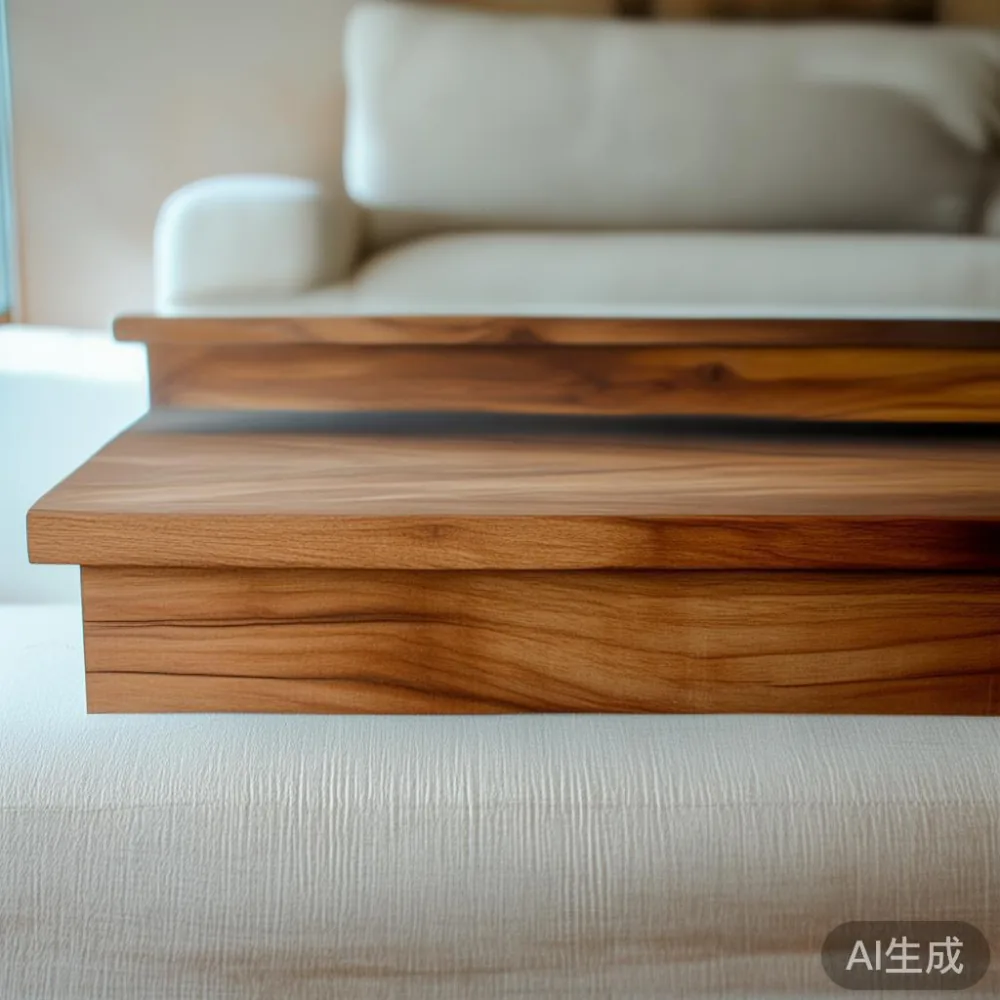
Solid wood moves differently. A solid oak dining table top breathes. In an air-con living room it can shrink 1 mm to 2 mm across a 1.8 m span when the indoor humidity drops below 45% overnight. That movement shows up as a hairline joint gap in mid-summer and a tight, sometimes slightly cupped surface in mid-winter. Critically, it is reversible: a controlled re-humidification and a wax-oil refresh brings the panel back. MIDHILL ships every piece with a small tin of maintenance wax and a 10-year structural warranty, and the lifetime refinishing service lets a Singapore owner refinish the dining table in the workshop for around SGD 180 to SGD 260 per piece, far less than replacement.
Fabric care links directly to this. A leather or fabric sofa placed two meters from a window that gets afternoon sun will dry-cure the hide and crack the fibres within 18 months; the same sofa ten metres back in a bedroom-cum-living corner will outlast the frame. For both veneer and solid wood, controlling indoor humidity between 45% and 60% with a SGD 60 dehumidifier is the single most cost-effective maintenance action a HDB or condo owner can take.
What does a "second life" really look like for each material?
This is the line item that buyers forget. A veneer wardrobe in a Punggol BTO will likely be disassembled and skip-disposed at the end of tenancy; the MDF core is light, the particleboard swells if it ever gets wet during the dismantling process, and second-hand buyers on Carousell usually offer SGD 20 to SGD 60 for a used three-door unit, sometimes free for collection. A solid wood wardrobe, by contrast, retains 30% to 45% of its original value after five years if the wood is oak, ash, or walnut. I have personally seen a five-year-old MIDHILL ash wardrobe resell in Bedok for SGD 1,150 against an original SGD 2,800 ticket — a 41% retention.
The same curve applies to dining tables. A printed-veneer table that has peeled at the edges is effectively valueless past year four; a solid oak dining table that has been refinished once in year three commands 50% to 65% of its original price on the Singapore second-hand market. Bed frames and nightstands sit in between: a solid wood queen bed frame typically resells for SGD 500 to SGD 900 after five years, against SGD 80 to SGD 180 for a flat-pack veneer equivalent.
Cumulatively, the residual value of a five-piece solid wood set after 60 months is approximately SGD 2,200 to SGD 3,600 higher than a comparable veneer set. That gap alone wipes out roughly half of the original price difference.
Is a solid wood sofa worth the extra weight in a Singapore lift?
Yes — with caveats, and the caveats are mostly about logistics. A three-seater solid wood sofa frame with kiln-dried ash base, pocket-spring seating, and removable linen-blend covers typically weighs 75 kg to 95 kg. A flat-packed veneer-base sofa weighs 38 kg to 55 kg. The weight gap matters because most Singapore HDB lifts cap out at 630 kg to 1,000 kg passenger load, and the usable cabin depth for a vertical sofa carton is roughly 180 cm. A 95 kg sofa will fit two men and the carton, comfortably; a 55 kg flat-pack sofa leaves room for the installers to stand. The constraint is rarely lift weight in practice — it is corridor turning radius, which sits at 1.4 m to 1.8 m on most 1990s-to-2010s HDB corridors and 1.8 m to 2.2 m on newer Punggol and Sengkang blocks.
The reason the weight question is worth asking: a heavier solid wood sofa frame is more stable on tile flooring, and it does not twist in the middle after 24 months the way a flat-pack with bolt-and-barrel-nut joinery can. The fabric care angle is also stronger on a solid base — a removable, washable cover on a fixed frame can be machine-washed 30 to 40 times without the frame warping underneath. For households with children or pets, that single factor can shift the five-year cost decisively in favour of a heavier sofa.
How do I choose a rattan wicker for a bedroom?
Pick tight, machine-woven rattan wicker over loose handweave if your bedroom sits on a higher floor with strong afternoon sun, because tighter weave resists UV drying for an extra two to three years before the fibres start to crack.
This answer deserves the full reasoning, because rattan wicker is the one material category where a "wrong" pick can lose half its value in 36 months. In a Singapore bedroom, the four variables that matter are: humidity stability (rattan prefers 50%-65%), UV exposure (north-facing windows roughly half the UV of west-facing), floor traffic (a bedside rug reduces abrasion four-fold), and the weight capacity of the weave (handweave averages 60 kg, machine weave 90 kg to 120 kg before sag). Choose handweave only if the piece is purely decorative — a stool you sit on twice a year — and never for the primary nightstand or headboard. Solid wood frames wrapped in woven rattan panels outlast all-rattan frames by 8 to 12 years in Singapore conditions; this is also why MIDHILL pairs woven rattan only with kiln-dried ash or oak cores, never MDF.
What does the five-year spreadsheet actually look like?
Using a representative five-piece set for a four-room HDB in Tampines or Bedok, here is the realistic five-year cost model in Singapore dollars, including GST (9%), standard doorstep delivery (free above the USD 350 / SGD 480 threshold that international workshops like MIDHILL apply), and one round of refinishing or repair in year three.
Veneer set, five pieces (bed frame, wardrobe, two nightstands, dining table): upfront SGD 4,200, year-three repairs SGD 480, year-five replacement of wardrobe doors SGD 620, residual value at 60 months SGD 220. Five-year net cost: SGD 5,080.
Solid wood set, same five pieces from a reputable Foshan workshop: upfront SGD 8,900, year-three refinishing of dining table and wardrobe SGD 420, no other repairs expected, residual value at 60 months SGD 3,100. Five-year net cost: SGD 6,220.
The net gap is SGD 1,140 over five years — roughly SGD 19 a month — for a set that has lasted longer, retained more value, and aged with character. Push the analysis out to ten years and the gap inverts completely: the veneer set is on its second replacement cycle, while the solid wood set has only needed one more round of wax and one handle swap.
Where does marble fit into a Singapore cost comparison?
Marble tabletops are the exception that proves the rule. A solid marble table — whether Carrara, Calacatta, or the more pragmatic grey-vein Spanish varieties — costs SGD 2,400 to SGD 6,000 for a 1.4 m dining table in Singapore, and it does not behave like wood at all. Marble is denser (2,600 kg/m³ against oak at 750 kg/m³), it does not respond to humidity, and it holds its temperature, which is why so many French light luxury and American light luxury interiors pair a marble table with a solid wood base — the wood softens the acoustics and warmth loss, the marble provides the surface that no veneer can imitate convincingly for more than three to four years. In Singapore terms, a marble table with an oak or ash base sits in the same lifetime-cost band as a solid wood table, with refinishing replaced by annual sealing (SGD 120 to SGD 180 per session).
So how should a Singapore buyer decide this week?
Start with the pieces you touch daily: the bed frame, the dining table, and the primary nightstand. These earn their solid wood premium back fastest through retained value and through fewer mid-cycle replacements. Move to the wardrobe second, but only if you have the floor space for a genuine three-door unit — a narrow two-door wardrobe is the most common place I see veneer failures because the door flex exceeds the edge-bond strength within 30 months. A French provincial coffee table in the living room, by contrast, can stay in veneer without guilt; it sees less daily contact and serves as a styling anchor, not a working surface. Buy solid wood where wear happens, buy veneer where aesthetics carry the room, and treat the corridor-and-lift logistics of your block as a hard constraint before you commit to a 90 kg sofa frame.
Finally, a word on fabric care that ties all of this together. Whether you choose a removable-cover sofa, a linen-upholstered bed frame, or a woven rattan headboard, the same five-year rule applies: rotate the covers quarterly, vacuum under cushions monthly, and keep indoor humidity in that 45%-60% window. Furniture — solid wood or veneer — ages predictably when the room is calm, and unpredictably when the room cycles. Choose the material that fits the way you actually live in Tampines, Bedok, or Punggol, and the five-year cost lines up in your favour.