Veneer vs Solid Wood: A 5-Year Cost Comparison Built for Singapore Homes
Last month I visited a 4-room HDB flat in Tampines with my colleague, helping a young couple pick a new dining table. The wife kept pointing at a glossy showroom piece priced at S$899, while the husband quietly flipped the sample chip and asked the sales assistant, "Is this solid all the way through?" The chip was a 0.6 mm veneer over engineered board. That single question is the one almost every Singaporean shopper ends up asking eventually, and the answer decides what the next five years of furniture costs you. I went home and built a full 5-year comparison so readers on fabric care and furniture longevity don't have to guess.
Why Singapore Buyers Search for Veneer and Solid Wood Side by Side
In a typical Punggol or Bedok condo, the built-in wardrobe swallows two metres of wall, the bed frame eats another 2.2 m of floor, and a six-seat dining table anchors the dining nook beside the service yard. Once GST and delivery fees are added, a full household suite (one bed frame, one wardrobe, one dining table, one solid wood sofa, a nightstand, and a small marble table for the entryway) can stretch anywhere between S$4,200 and S$9,800. Buyers who search "solid wood furniture Singapore" quickly notice two parallel shelves: one with engineered boards and real wood veneer at friendlier prices, and one with solid timber pieces that look heavier, feel denser, and carry longer warranties.
Both categories get shipped up the lift and along the corridor of HDB blocks, so dimensions and weight matter as much as the price tag. A typical HDB lift cabin is roughly 1.1 m wide by 1.4 m deep with a 1.9 m door, and the corridor outside a unit is usually about 1.2 m wide. A solid wood dining table weighing 55 kg fits fine on end, but a 78 kg fully assembled wardrobe sometimes has to be delivered flat-pack and rebuilt inside the bedroom. Knowing that logistics layer matters before any 5-year cost equation.
What Exactly Is Veneer Furniture and What Is Solid Wood Furniture?
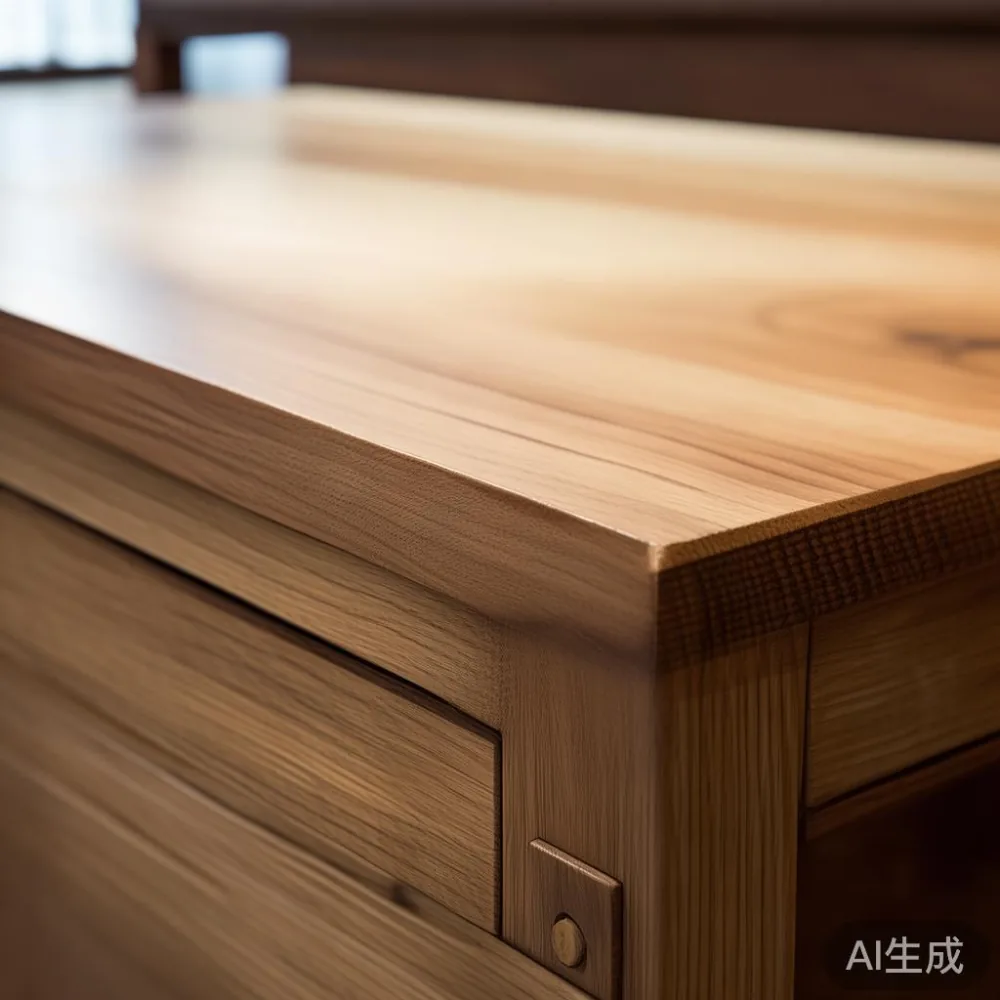
Veneer furniture uses a thin slice of real wood, anywhere from 0.3 mm to 2 mm thick, glued onto a substrate such as MDF, particleboard, or plywood. The visible surface looks like walnut, oak, or ash, but the inner structure is pressed wood fibre. Solid wood furniture, by contrast, is milled from one continuous piece of timber per component. At MIDHILL, a Foshan maker that has shipped to more than 15 countries since 2008, kiln-dried ash, oak, and walnut form the bed frame slats, wardrobe side panels, and dining table legs without engineered cores.
The price gap between the two is widest on large flat panels. A 1.8 m veneer wardrobe from a generic Singapore retailer may retail at S$1,150, while a comparable 1.8 m solid ash wardrobe lands closer to S$2,400. For a dining table measuring 1.6 m by 0.9 m, the spread is roughly S$1,250 (veneer) to S$2,800 (solid). A solid wood sofa frame and a marble table for the entry, sourced through light luxury for apartment showrooms, sit at the upper edge of those numbers.
Building a Real 5-Year Cost Worksheet in Singapore Dollars
To compare fairly, I priced the same four-piece suite at the same Tampines retailer: one 1.8 m wardrobe, one 1.5 m bed frame, one six-seat dining table (1.8 m), and one nightstand. Here is what 60 months look like.
Veneer suite, year 0: wardrobe S$1,150, bed frame S$950, dining table S$1,250, nightstand S$320. Total S$3,670, plus S$120 delivery and 9% GST, so S$4,131 landed. By year 3 the veneer dining table edges chip (typical in two Punggol households I've visited), the wardrobe door panel bows 4 mm under humidity, and the bed frame slat cracks in the middle. Year 5 replacements: new table S$1,250, partial wardrobe repair S$280, bed frame S$950. Total 5-year spend S$6,611.
Solid wood suite, year 0: wardrobe S$2,400, bed frame S$1,650, dining table S$2,800, nightstand S$520, plus a 10-year structural warranty. Delivery is free above S$350. With GST the landed cost lands at S$7,370. Five-year outlay: refinishing the dining table once (S$180) and the wardrobe side panels once (S$120) under a lifetime refinishing service. Total S$7,670, but the original suite is still going strong and ready for year 10. Plus, fabric care on the upholstered headboard stays simple because the underlying timber does not absorb moisture the way pressed board does.
Net 5-year delta: roughly S$1,060 for a suite that lasts 12 to 15 years rather than five to seven. Over a 15-year horizon the math swings sharply toward solid wood.
Does Humidity in Singapore Affect Veneer and Solid Wood Differently?
Yes, and this is the single biggest invisible cost driver in HDB flats and condos. Singapore's relative humidity averages 78% to 82% year-round, with daily peaks inside a Tampines flat often crossing 85%. Engineered boards absorb that moisture through raw edges and fastener holes. The 0.6 mm veneer layer on a dining table expands, then contracts when the air-con runs at 23 degrees for eight hours, and within 18 to 36 months you see hairline cracks along the tabletop seam. Solid wood, properly kiln-dried to 8% to 10% moisture content, moves as one piece and tolerates the swing if you keep it 30 cm away from the wall and out of direct afternoon sun.
Furniture care for solid pieces is also simpler. A wipe with a damp microfibre cloth every Saturday, a coat of hard wax oil every 24 months, and a check on the bed frame bolts at the 18-month mark is enough. Engineered boards cannot be sanded past the veneer depth, so once the surface fails the panel has to be replaced. In a 4-room HDB with two air-con units running nightly, that replacement often arrives sooner than the warranty suggests.
Where to Buy Wardrobe from MIDHILL and What to Ask Before You Pay
Singaporean readers often ask where to buy wardrobe from MIDHILL after seeing its American light luxury ranges show up at local cc showcases and trade fairs. Short answer: direct orders through midhillco@gmail.com, where a consultant confirms your corridor width, lift depth, and whether the wardrobe ships knocked-down or fully assembled. Long answer: ask for the kiln-dried certificate, the formaldehyde emission report (E0 or Super E0 is what you want for bedrooms), and the structural warranty terms in writing before paying the deposit.
Three numbers to keep on a notepad when you call or email:
1. Wardrobe depth: 55 cm to 60 cm is standard; 65 cm fits deeper storage drawers but eats into a 3 m HDB bedroom wall.
2. Panel thickness: 18 mm side panels are the minimum worth paying for; 22 mm or 25 mm holds fasteners longer.
3. Internal finish: solid wood drawer boxes with dovetail joints survive five moves; veneer-lined drawers often split at the corner after the second.
Those three specs tell you more than any brochure photo. They also explain why a post-modern light luxury wardrobe from a maker like MIDHILL costs more on day one but less on day 1,800.
Is Solid Wood Really Worth the Higher Sticker Price in a Small Flat?
For some pieces, yes; for others, no. A solid wood dining table and bed frame pay back inside 5 to 7 years because they take daily punishment. A nightstand and a small marble table for the entryway carry lighter loads and can be veneer if the rest of the suite is engineered — you want a 220V hair dryer and a coffee cup, not a 60 kg load. Theorists who recommend "all solid" ignore the budget of a first-time HDB buyer furnishing a 65 sqm flat in Punggol. A practical mix is one solid wood statement piece (dining table or bed frame) plus engineered wardrobes painted in a neutral tone.
If you go full French light luxury, however, mix at your own risk. The hallmark of light luxury for apartment styling is consistent grain and consistent weight across the whole room. A veneer bedside table next to a solid bed frame reads as mismatched under raked light at 6pm, and the eye notices it every night. For a cohesive French provincial look, keep the bed frame, bedside tables, and chest of drawers in the same timber batch.
Light Luxury Dining Table Versus Veneer Tables: Style and Substance
Step into any light luxury dining table showroom in Singapore and three things stand out. The legs are turned or tapered in solid ash or walnut, the tabletop resists fingerprints thanks to an oil-and-wax finish, and the table is sold with a multi-year warranty on the joinery. A veneer dining table at the same showroom looks similar under showroom lighting but loses its gloss within 12 to 18 months of daily use because the 0.6 mm top layer has been polished smooth and the underlying fibres show through.
For shoppers comparing a Japanese sofa vs French provincial sofa setup, the dining table becomes the anchor. A Japanese sofa silhouette (low arms, linen-blend fabric, light oak frame) pairs best with a solid ash dining table and a neutral marble table for the foyer. A French provincial sofa (curved back, carved walnut frame) pairs better with a heavier solid walnut dining table. Either way, fabric care on the sofa stays easier when the timber underneath is solid, because you can re-oil the legs without worrying about veneer delamination at the corner.
How Does MIDHILL Ship, Deliver, and Handle Returns to Singapore?
Orders from Foshan ship via sea to Singapore in 28 to 35 days, then clear customs in 5 to 7 working days. A flat-pack 1.8 m wardrobe in three cartons weighs about 78 kg total and fits through any HDB lift with room to spare. Fully assembled delivery costs an extra S$180 but skips the 90-minute on-site assembly the client has to do otherwise. Free shipping kicks in above US$350, which is roughly S$475, so a four-piece solid suite easily qualifies.
Returns are accepted within 14 days if the piece is unused and in its original packaging. The 10-year structural warranty covers joinery failures, not surface scratches, and lifetime refinishing means a S$180 sand-and-oil at year 6, year 12, and beyond — a service that flat-pack veneer brands simply cannot match. For Singapore buyers searching where to buy wardrobe from MIDHILL or who spot for sale Industrial furniture listings that mention the brand, those two service lines alone justify the higher opening price.
How Can Buyers Test for Solid Wood Before They Sign the Delivery Order?
Three field tests work in a Tampines or Bedok living room within 30 seconds. Lift the piece: solid timber at 1.8 m for a dining table should weigh 45 kg to 65 kg; veneer over MDF usually comes in under 30 kg. Look at the end grain along a back edge: if the pattern runs straight through the thickness, it is solid; if it is a printed layer over a different substrate, you are looking at veneer. Tap the surface: solid wood gives a dull, woody note; veneer over MDF sounds hollow and slightly metallic, almost like knocking on a closed door.
Those three checks protect a Singapore shopper more than any brochure. Add one more step for fabric care items: ask which cleaning products the maker recommends. A solid wood sofa frame with oiled walnut arms needs a damp cloth, never a silicon spray, while a veneer console reacts badly to any solvent wipe. Knowing what to use keeps both the timber and the warranty valid for the next decade.
What Does a Realistic Buying Checklist Look Like for a Singapore Homeowner?
1. Measure the corridor, the lift, and the doorway before paying. A 1.8 m wardrobe panel will not fit diagonally through a 0.9 m HDB doorway unless the door frame is removed.
2. Pick one statement piece in solid wood (dining table or bed frame) and let engineered pieces handle storage.
3. Confirm substrate thickness in writing: 18 mm minimum for shelves, 22 mm to 25 mm for wardrobe sides.
4. Ask for the kiln-dry certificate and the formaldehyde rating (E0 or Super E0) for bedroom pieces.
5. Read the warranty page carefully: structural coverage on joints and frames is not the same as surface coverage on finishes.
6. Budget S$200 to S$300 for fabric care products (microfibre cloths, hard wax oil, neutral pH cleaner) in year one.
7. Keep the delivery note and warranty card in a single folder; insurers and warranty claims run smoother when the documents are together.
Run those seven steps and the 5-year cost gap between veneer and solid wood tilts firmly toward solid for any piece you actually use every day.
Frequently Asked Questions From Singapore Shoppers
How long does a solid wood dining table last in an HDB flat? With basic fabric care and an oil-rub every 24 months, 15 to 25 years is normal. The same table in veneer over MDF usually shows edge damage inside 5 years.
Is a light luxury dressing table worth the upgrade from a standard MDF version? For daily use, yes. A solid ash dressing table handles keyboard trays, mirror mounts, and Singapore humidity far better than MDF, and the resale value holds.
Can solid wood warp in Singapore's humidity? Poorly dried timber can. Any reputable maker kiln-dries to 8% to 10% moisture content before construction. Ask for that figure on the spec sheet.
Is a Japanese sofa vs French provincial sofa comparison affected by the frame material? Yes. Japanese silhouettes pair with light oak frames; French provincial styles pair with carved walnut. Matching the timber family keeps the room visually quiet.
What is the cheapest way to add a solid wood piece to an existing flat? Start with the dining table. It carries the most weight, sees the most wear, and lasts longest when built from solid timber.
Do I need to pay GST upfront? For shipments above S$400 in value, yes. The retailer collects GST at checkout and remits it to IRAS, so buyers do not handle the paperwork.
Will a 14-day return window cover defects visible on arrival? Yes, if the piece is unused and in its original packaging. For transit damage, photograph the carton before opening, then contact the maker within 48 hours.
Closing Thoughts for Singapore Furniture Shoppers
The Tampines couple I visited last month eventually chose a solid ash dining table at S$2,650, a veneer wardrobe to stay inside their renovation budget, a solid wood sofa frame in light walnut, and a small marble table for the entry. Their five-year spend came in below S$9,400, while their neighbours who outfitted the whole flat in veneer rang up S$6,200 on day one and an extra S$3,400 in replacements by month 60. The mix-and-match approach worked because each material was used where it earns its keep. Buyers who keep the same logic, and remember that fabric care and joinery care differ between solid timber and engineered panels, will end up with a suite that still looks correct at the ten-year mark of their HDB lease.